Creating Arrays
In the previous lesson, you learned how to store individual values using variables and constants. In this lesson, you will learn how to work with a group of related values by using arrays. Arrays are extremely useful when you need to store many items of the same data type, such as a list of names, marks, prices, or scores.
Instead of declaring many separate variables such as Name1, Name2, Name3, and so on, you can use one array name and distinguish each item by its position, also called an index or subscript.
Lesson Overview
10.1 Introduction
What Is an Array?
A group of variables of the same data type is known as an array in Visual Basic 2015. If you only need to store a single value, one variable is enough. However, if you need to store many similar items, using separate variable names becomes tedious and hard to manage.
For example, if you want to store 100 customer names, it would be inconvenient to declare 100 different variables. Instead, you can declare one array and then refer to each item by its position:
Name(0), Name(1), Name(2), Name(3) ...Each position number is called an index or subscript.
10.2 Dimensions
One-Dimensional and Two-Dimensional Arrays
In Visual Basic 2015, an array can be one-dimensional or multidimensional. Most simple programs use one-dimensional or two-dimensional arrays.
A one-dimensional array is like a list of items arranged in one row or one column. A two-dimensional array is like a table made up of rows and columns.
To reference an element in a one-dimensional array, use:
ArrayName(x)To reference an element in a two-dimensional array, use:
ArrayName(x, y)| Student Name | Name(0) | Name(1) | Name(2) | Name(3) | Name(4) | Name(5) | Name(6) |
| Name(0,0) | Name(0,1) | Name(0,2) | Name(0,3) |
| Name(1,0) | Name(1,1) | Name(1,2) | Name(1,3) |
| Name(2,0) | Name(2,1) | Name(2,2) | Name(2,3) |
| Name(3,0) | Name(3,1) | Name(3,2) | Name(3,3) |
10.3 Declaration
Declaring a One-Dimensional Array
In Visual Basic 2015, you can use either the Dim statement or the Public statement to declare an array.
- Dim creates an array that is local to a procedure or module.
- Public creates an array that can be used throughout the application.
The syntax for a one-dimensional array is:
Dim arrayName(n) As dataTypeHere, n indicates the last index in the array, not the number of elements. Since Visual Basic arrays normally start at index 0, an array declared as (10) actually contains 11 elements, from index 0 through index 10.
Dim CusName(10) As StringThe array above contains 11 string elements:
CusName(0) ... CusName(10)To find the total number of elements in an array, use:
arrayName.Length10.3 Example 10.1
Finding the Length of a One-Dimensional Array
Private Sub Form1_Load(sender As Object, e As EventArgs) Handles MyBase.Load

    Dim CusName(10) As String
    MsgBox(CusName.Length)

End Sub
When the program runs, the message box displays the length of the array, which is 11.
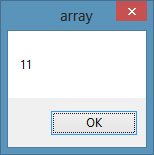
Figure 10.1: The length of the array is displayed as 11
10.3 Alternative Syntax
Declaring an Array with Initialized Values
You can also declare an array and initialize it with values in a more flexible way:
Dim arrayName As DataType()
arrayName = New String() {1, 2, 3, ...., n}
This approach creates the array with the values you provide immediately.
10.3 Example 10.2
Array with Three Initialized Values
Private Sub Form1_Load(sender As Object, e As EventArgs) Handles MyBase.Load

    Dim CusName As String()
    CusName = New String() {1, 2, 3}
    MsgBox(CusName.Length)

End Sub
In this example, the length of the array is 3 because the array contains three elements.
10.4 Two-Dimensional Arrays
Declaring a Two-Dimensional Array
The syntax for declaring a two-dimensional array is:
Dim ArrayName(m, n) As dataTypeHere, m and n are the last indices in the two dimensions. The total number of elements is:
(m + 1) × (n + 1)For example, if you declare:
Dim CusName(5, 6) As Stringthen the total number of elements is:
(5 + 1) × (6 + 1) = 4210.4 Example 10.3
Finding the Length of a Two-Dimensional Array
Private Sub Form1_Load(sender As Object, e As EventArgs) Handles MyBase.Load

    Dim CusName(5,6) As String
    MsgBox(CusName.Length)

End Sub
When the program runs, the message box displays the length of the array as 42.
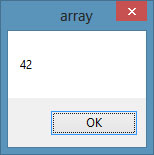
Figure 10.2: The length of the two-dimensional array is displayed as 42
10.5 Practical Example
Storing Multiple Names in an Array and Displaying Them in a ListBox
The following example shows how to collect six customer names from the user and store them in an array. Each name is entered through an InputBox and then added to a ListBox.
Private Sub Form1_Load(sender As Object, e As EventArgs) Handles MyBase.Load
    Dim num As Integer
    Dim CusName(5) As String

    For num = 0 To 5
        CusName(num) = InputBox("Enter the customer name", "Enter Name")
        ListBox1.Items.Add(CusName(num))
    Next
End Sub
This example combines several ideas you have learned earlier:
- InputBox collects user input.
- CusName(num) stores each entered name in the array.
- For...Next repeats the input process six times.
- ListBox1.Items.Add(...) displays the names in the list box.
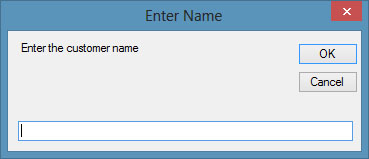
Figure 10.3: Entering customer names through an InputBox
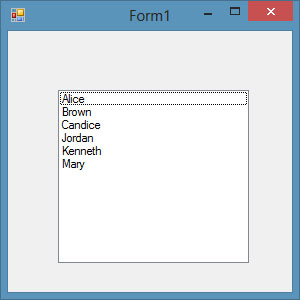
Figure 10.4: The customer names displayed in the ListBox
10.6 Why This Matters
Why Arrays Are Useful
Arrays let you store and manage many related values efficiently under one name. This makes your code cleaner, shorter, and easier to maintain. As your programs become larger, arrays become essential tools for handling repeated or grouped data.
Recommended Upgrade
Build on This Foundation
Continue to VB2026
After learning the basics of arrays in VB2015, move to the newest VB2026 tutorial for a more modern VB.NET learning path.

Visual Basic Programming
Use this Top Release book to reinforce your tutorial learning with a more structured guide.
Practice
Exercise Questions
- What is the difference between a one-dimensional array and a two-dimensional array?
- If you declare Dim Score(4) As Integer, how many elements does the array contain?
- Write a short VB2015 example that stores five names in an array and shows them in a ListBox.